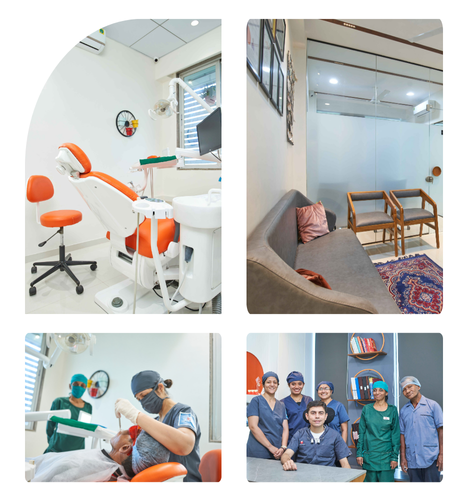
A patient guide from NxtDent Dental Clinic in Adajan, Surat. The right fit for your bone and your tooth matters far more than the price tag or the brand name. Read the guide, then try the fit finder to see what your dentist is likely to discuss with you.
NRI and dental tourism patients welcome. We plan your visits around your travel.
Hundreds of implant brands. Your dentist shortlists very few.
More than 450 companies around the world make dental implants. Your dentist is not choosing from a catalogue by price. A few clear criteria decide what goes into your jaw.
Registered in India, or dealer-based?
A company registered in India stands behind service and spare parts in the future. A dealer-based brand can change dealers, and consumables become hard to find years later.
What research stands behind it?
Many implants are copies with little research of their own. Very few, like Straumann, a pioneer with over 30 years of research behind its designs, have a proven record. That research is part of why premium systems cost more.
Which range is sold in India?
Some brands keep their surface-treated, higher-grade ranges for selected markets. What is supplied in India may be the standard budget range, so the actual model matters, not only the brand name.
How your dentist decides, in this order
1Bone density
2Site: front or back
3Timing: immediate, early or delayed
4Your general health
5Brand support and research
6Budget, last
Cost is considered only after the clinically right choice is clear. A mismatched implant costs far more later than the difference in price today. We also consider where you live. For NRI and dental-tourism patients we often suggest premium systems, because the same genuine pack costs far less here, and we plan grafting and visits around your travel.
An implant is a long-term investment, not a phone
A flagship phone costs about as much as an implant, or more. Even a good mid-range phone is usually replaced within 3 to 5 years. A well-chosen implant, looked after, can serve for decades.
How long does it last?
Phone: 3 to 5 years
Implant: decades. We have seen 23 years and counting.
Some of our patients have had the same implants working for 23 years.
What upkeep looks like
Regular check-ups, health visits and hygiene visits
The abutment screw is changed at regular intervals, mostly every 5 years
The crown or abutment is sometimes replaced after 15 to 20 years
The implant itself usually stays. It is the crown on top that needs the upkeep.
Budget matters. But what is the use if an implant fails early, does not last, or needs repeated maintenance and revisits? That ends up costing more than a premium choice paid for once. So we choose by science first: design, surface, company and research. Then we talk about cost.
Why one implant does not suit every jaw
Your jaw is living bone, not a shelf for a fitting. Think of the bone as the road, and the implant as the vehicle and tyres.
Expressway sedan
Dense lower-front bone. A passive to mid-range thread glides in without stress.
Off-road 4x4
Upper jaw, or a fresh or early extraction site. A deep, aggressive thread bites in and holds.
Heavy truck
Back molars carry the load. They need strength and a collar that is easy to keep clean.
Where the tooth sits decides the collar
Every implant has a rough surface that bonds with the bone. What happens above that surface is what separates tissue-level from bone-level.
Our first preference: back teeth, sometimes lower front
Tissue-level implant
The rough implant body goes deep into the bone. Above it, a smooth polished collar comes out of the bone and joins the gum. The gum forms a solid, tight seal around the collar, a natural defence against bacteria and plaque. That makes it easier to maintain and helps it last.
Easy to clean and maintain, which matters most in back teeth
Takes higher chewing load, with more fracture resistance than bone-level
No second-stage surgery
Integrates very well with the soft tissue, keeping the gum healthy
Where aesthetics demand it
Bone-level implant
The rough implant sits at the bone crest, or about 1 mm below it, and the crown rises directly from it through a company-fitted abutment, zirconia or titanium. The joint between the crown and the implant is right at the bone, where bacteria can collect. That makes it more prone to peri-implantitis, an infection of the gum and bone around an implant.
Used in the upper front teeth, where tissue-level cannot be placed for aesthetic reasons, and sometimes in the lower front
A choice for full-mouth rehabilitation cases
When aesthetic demands are high, such as a high smile line
In simple words: a tissue-level implant has a polished collar that comes out of the bone and seals with the gum, like a closed door against bacteria. A bone-level implant has no collar: the crown joins the implant right at the bone, where bacteria can settle. That is why tissue-level is our first preference, and bone-level is used where the smile demands it, mainly the upper front teeth.
How aggressive should the thread be?
Threads give the implant its first grip while your bone heals around it. Our implants range from very aggressive, for maximum grip, to passive and gentle. The right one depends on the jaw, the bone and the timing.
← Most aggressive: maximum gripPassive: gentle →
Where and when
Our usual choice
Why
Upper jaw, immediate or early placement
X-design first choice
The whole upper jaw, front and back, has soft bone and needs maximum grip. If needed we move down the list: C-design, Neodent GM, Osstem.
Upper jaw, healed site
Lean aggressive: C-design or X-design
All designs are possible in a healed site, but the upper bone is usually soft, especially in the upper back teeth. We want more grip, so our choice leans towards the aggressive end.
Lower back teeth, immediate or early placement
TLC first choice
A mid-range design, not the most aggressive and not the most passive. Neodent GM or Osstem also fit. X-design only if the septal bone allows and extra grip is needed. We load the same day only if the torque is high.
Lower back teeth, healed dense bone
TLC, BLT or TL
All designs are possible in dense healed bone. Passive to mid designs are preferred, and aggressive X-design is not needed. Economic choice: Osstem or Neodent GM.
Lower front teeth, the densest bone
BLT or tissue-level (TL)
We prefer gentle here. Tissue-level is completely passive and BLT is mildly aggressive. Economic choice: Osstem first, then Neodent GM. We can go more aggressive if needed, but usually do not. Tissue-level also suits because this area usually sits under the lip.
When we lean towards a surface-treated implant
A surface-treated implant heals faster. Neodent GM Aqua is our economic choice, and Straumann SLActive is our premium choice.
1
You want premium quality
Straumann is a very well-researched premium brand that builds its implant designs on research, with over 30 years behind it.
2
You want teeth within 2 to 3 months
Surface-treated implants can often be loaded in about 2 months if no grafting is needed.
3
Smokers, tobacco chewers, diabetics, medical conditions
Healing is more demanding, so we lean strongly towards a surface-treated implant, with closer follow-up.
4
You need bone grafting
A surface-treated implant attracts more bone formation, so it works together with the graft.
How will you know how your bone is?
You cannot tell by looking in the mirror or by feel. Bone quality is measured, in three steps.
1
Clinical examination
Your dentist checks gums, bite, neighbouring teeth and how widely you can open.
2
X-rays and 3D scan
An OPG gives the overview. A CBCT 3D scan measures bone height, width and density, and shows the sinus and nerve positions.
3
Confirmed in surgery
The surgeon also feels the bone while preparing the site, and can adjust the plan on the day.
Dense bone (D1 to D2) More common in the lower jaw.
Soft bone (D3 to D4) More common in the upper jaw.
How long has the tooth been missing?
This matters as much as bone density. Bone shrinks after an extraction, fastest in the first months, so we prefer to act early.
Day of extraction
Immediate placement
The implant goes in as the tooth comes out, when bone and gums allow. An aggressive design gives the grip. We load the same day only if the insertion torque is high.
Within about 3 months
Early placement
After a short healing period, while the bone is still well preserved, though a little soft. Our preferred window for back teeth.
More than 3 months
Bone may have shrunk
A scan will show whether grafting is needed first. Grafting adds healing time.
If the bone is less favourable at the time of extraction, we may suggest socket preservation or bone grafting first. With immediate implants we also graft most of the time, to fill the small gap between the implant and the socket wall so it matures into bone on its own.
Visiting from abroad? NRIs and dental tourists
Many of our patients fly in for treatment. We plan the work around your travel.
1
Visit one
If the bone is healed and sound, we can place the implant. Most of the time we go for an immediate implant at extraction, with bone grafting around it where needed.
2
If time or bone does not allow
Only rarely, when the site is not healed or the bone is very weak, we suggest socket preservation or bone grafting first. A graft can hold the bone for at least 8 months to a year.
3
Your next visit
We fix the next appointment so you can fly back comfortably after healing. We then place the implant if needed, or start the loading process.
Same genuine premium pack, far lower cost. A Straumann BLX that can cost Rs 2.5 to 3 lakh in the USA, UK or other developed countries costs around Rs 85,000 here. With several implants, the savings often cover the flights. Figures are indicative. Please ask us for a written quote.
Common implant systems, in plain words
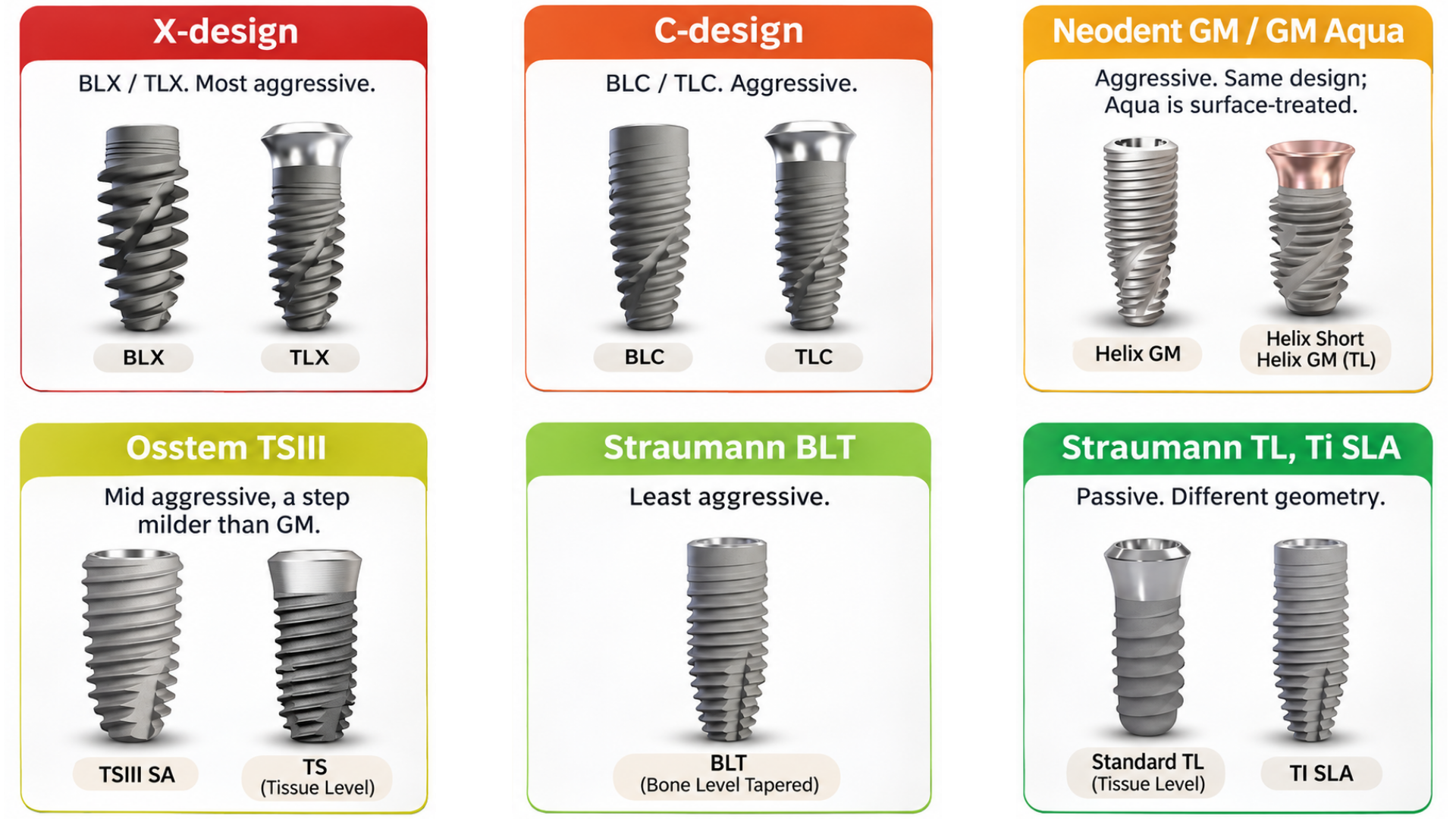
Listed from the most to the least aggressive thread. The right system is the one that fits your jaw, bone and timing. Price follows from that choice. Straumann BLT and tissue-level come in two surfaces: standard Ti SLA and the surface-treated SLActive.
Upper jaw in immediate or early placement: first choice. Extraction sockets, upper-front same-day teeth, soft bone. In full-arch cases, only rarely and only in the upper jaw.
Fast healing Can be loaded in about 2 months if not grafted.
TLC is first choice in lower back teeth, fresh or healed. Also healed upper sites. Premium full-arch choice (BLC). Designed by Straumann, a brand built on over 30 years of research.
Fast healing Can be loaded in about 2 months if not grafted.
Neodent GM Standard surface
Aggressive
Economic choice. Upper jaw, and mid-range use in the lower jaw.
Standard About 3 to 4 months.
Neodent GM Aqua Surface-treated
Aggressive
The same design with a surface that speeds up healing. Economic choice for fast healing.
Fast healing Can be loaded in about 2 months if not grafted.
Osstem TSIII Standard surface
Mid aggressive, a step milder than GM
Economic choice. Upper jaw, lower back and lower front (first economic choice there). The standard range supplied in India.
Standard About 3 to 4 months.
Straumann BLT, Ti SLA Standard surface (Ti SLA)
Least aggressive
Premium choice for the lower front and dense bone.
Standard About 3 to 4 months.
Straumann BLT, SLActive Surface-treated
Least aggressive
The same design, surface-treated, for fast healing or medically compromised patients. Premium full-arch choice.
Fast healing Can be loaded in about 2 months if not grafted.
Straumann tissue-level (TL), Ti SLA Standard surface (Ti SLA)
Passive
Completely passive. Dense bone, back teeth for hygiene, and the lower front under the lip.
Fast healing Can be loaded in about 2 months if not grafted.
Full-arch (All-on-4 / All-on-6)
Four to six implants per jaw carry a fixed bridge. Premium: Straumann BLT or BLC with SLActive, in both jaws, and only rarely BLX in the upper jaw. Balanced cost: Neodent GM or Osstem; GM Aqua for faster healing.
Fast with surface-treated systems.
✓ Fast healing is a plus point. Surface-treated systems can be loaded in about 2 months if no grafting is needed, even in full-arch cases. If grafting is done, the wait is longer, but a temporary tooth is often still possible.
Find your likely fit ★
Now that you know the basics, answer a few questions. This is only a conversation starter.
★ For your knowledge only. Clinical and radiographic assessment is needed before any recommendation is finalised. The final selection is made by your operating dental surgeon.
Your scan confirms the actual bone density. Jaw and position tell us what is usual.
Your likely discussion points ★
Dental implant questions, answered
Straight answers to the questions our patients in Surat ask most.
How long does a dental implant last?
A well-chosen implant, looked after, can serve for decades. Some of our patients have had the same implants working for 23 years. Upkeep means regular check-ups and hygiene visits, changing the abutment screw at regular intervals (mostly every 5 years), and sometimes replacing the crown or abutment after 15 to 20 years. The implant itself usually stays. It is the crown on top that needs the upkeep.
Is a cheaper dental implant worse?
Price should be the last factor, not the first. Your dentist chooses by bone density, the position of the tooth, timing, your general health, brand support in India and the research behind the system. An implant that fails early or needs repeated maintenance and revisits ends up costing more than a premium choice paid for once.
Which dental implant is best for back teeth?
Our first preference for back teeth is a tissue-level implant. A smooth polished collar comes out of the bone and seals with the gum, a natural defence against bacteria and plaque. It is easier to clean and maintain, takes higher chewing load and needs no second-stage surgery.
How soon can I get my teeth after an implant?
Surface-treated implants can often be loaded in about 2 months if no grafting is needed. Standard surfaces usually take about 3 to 4 months. A temporary tooth on the same day is possible only if the implant has high insertion torque. With bone grafting the wait is longer. Your operating dental surgeon makes the final decision after clinical and radiographic assessment.
Can NRIs and dental tourists get an implant in one trip?
Most of the time we go for an immediate implant at the first visit, with bone grafting around it where needed. Only rarely, if the site is not healed or the bone is very weak, we graft first. We then fix the next appointment so you can fly back comfortably after healing, for implant placement if needed or to start loading.
How will I know if I have enough bone for an implant?
You cannot tell by looking or feeling. Bone is measured with a clinical examination, an OPG X-ray and a CBCT 3D scan, which show bone height, width, density and the position of the sinus and nerves. The surgeon confirms it again during surgery.
Do I need a bone graft or socket preservation?
If the bone is less favourable at the time of extraction, we may suggest socket preservation or bone grafting first. This is also useful for patients who cannot return within 3 months, because a graft can hold the bone for at least 8 months to a year. With immediate implants we also graft the small gap around the implant most of the time.
Ask your dentist
On my scan, is this bone dense or soft, and which thread design are we using?
For my back tooth, can we use a tissue-level collar that is easy to clean?
Will my crown be screw-retained with an original manufacturer abutment?
Do I need socket preservation or a bone graft, and how does that change my timeline?
Do I get the implant brand card with serial number?
What a good plan includes
A 3D scan (CBCT) to check bone before choosing
Screw-retained crowns, so no cement is left under the gum
Original abutments, so parts stay available for years
Zirconia for the smile zone, strong zirconia or metal-ceramic for molars
A written maintenance and review schedule
Visit Us
We’re conveniently located in the Adajan area, on the 4th floor of the White Orchid building. Enjoy ample free parking right on-site.
401, White Orchid, Near Shell Petrol Pump, Above People's Dine Restaurant, L P Savani Main Road
Adajan Gam, Surat, Gujarat 395009